Share this



If your KiwiSaver balance or returns feel disappointing, it can be tempting to react quickly. But before changing funds or providers, it helps to check whether you are in the right type of fund first, whether you are comparing like with like, and what trusted guidance says to look at before making a move.
Please note: This article is intended as general information only and does not constitute financial or investment advice. KiwiSaver decisions depend on your personal goals, time horizon, risk tolerance and circumstances. Before making changes to your KiwiSaver, consider reviewing trusted provider information or seeking guidance from a qualified financial adviser.
What to check before you switch
When KiwiSaver headlines turn negative, or when someone else says their fund has done better than yours, it is easy to feel that you should be doing something.
Sometimes a switch is the right call. But not always.
Sorted’s guidance is clear that before comparing performance, you should first make sure you are in the right type of fund for your timeframe and attitude to risk.
That matters because KiwiSaver funds are built for different jobs. Sorted groups KiwiSaver funds into categories such as conservative, balanced, growth and aggressive, and says the right fit usually depends on how long you are investing for and how comfortable you are with ups and downs in your balance.
Consumer NZ makes a similar point, noting that different funds carry different levels of risk and return, and that the right choice depends heavily on when you are likely to need the money.
-1.png)
Expert-Sourced Guidance
This article draws mainly on guidance and tools from Sorted, including its KiwiSaver guides and Fund Finder, along with fund information and investor guidance from providers including Simplicity, Kernel, ANZ and Kiwibank.
Together, these sources help explain how fund type, timeframe, risk and fees fit together when reviewing KiwiSaver options.
Start with the fund type, not the provider name
For many Members, this is the most important point.
Before comparing KiwiSaver providers, check whether you are in the right type of fund.
A simple way to think about it is this:
- If you may need the money sooner, a lower-risk fund may be more appropriate.
- If you are investing for much longer, a higher-growth fund may be worth considering because it has more time to ride out market movements.
- If you are somewhere in the middle, a balanced fund may be closer to the right fit.
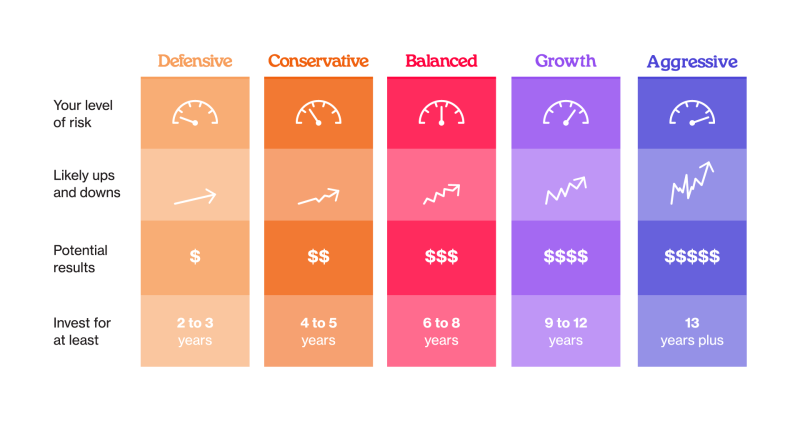
Sorted says the fund type that suits you will usually depend on how long you are investing for and your attitude to risk.
Simplicity says its Conservative KiwiSaver Fund has a minimum suggested investment timeframe of 3 years, while its broader KiwiSaver fund range shows balanced, growth and high-growth options built around increasing exposure to growth assets.
ANZ says the minimum suggested investment timeframe refers to when you plan to withdraw some or all of your savings, such as for a first home or retirement.
That is important because different fund types are meant to behave differently. A conservative fund will usually move around less, but it also has lower long-term growth potential. A growth fund may deliver stronger returns over a longer period, but it will usually come with more ups and downs along the way.
So, if you are comparing a conservative fund with a growth fund, or a balanced fund with an aggressive fund, the results can be misleading.
The growth fund may look better over some periods, but it is also taking more investment risk to get there. Sorted says the better comparison is usually between funds of the same type, not simply whichever fund has the strongest recent return.
Before deciding your KiwiSaver is underperforming, ask yourself: Am I comparing my fund with the right fund type?
A more practical way to review your KiwiSaver is:
- Work out when you are likely to need the money.
- Check which fund type generally suits that timeframe and your comfort with risk.
- Only then compare providers and funds within that same category.
That will not answer every question on its own. But it is a much stronger starting point than jumping straight to provider rankings or recent returns.

Do not judge a long-term investment by short-term noise alone
One disappointing period does not automatically mean you are in the wrong fund.
KiwiSaver is a long-term savings scheme, and returns can move around a lot from year to year, especially in higher-growth funds.
This is the practical reason not to jump too quickly:
- a conservative fund may look steadier, but it will usually grow more slowly over time
- a growth fund may look stronger over the long run, but it will usually have more ups and downs
- a fund that looks weak over one short period may simply be behaving as that type of fund normally does
-
the more useful question is whether your fund has been lagging behind similar funds over time, not whether it has disappointed you recently
Sorted is particularly clear on one point: hearing that another fund has done better is not, on its own, a good reason to switch.
So before treating a short-term dip or a disappointing year as a reason to move, it helps to ask: Is this a temporary setback, or does it look like my fund has been consistently behind other funds of the same type over time?

Compare the right things
Once you know the fund type that suits you, the next step is to compare the funds within that fund type.
Sorted’s Fund Finder is designed to help with that. It compares funds of the same type and lets users review fees, service measures and five-year returns side by side.
Sorted says this helps users select from the entire KiwiSaver market based on the appropriate level of risk, estimated fees over their KiwiSaver lifetime, the quantity and type of services offered by a provider, and five-year performance relative to similar funds.
That is a useful middle ground. You do not want to ignore weak performance altogether, but you also do not want to treat one number or one period as the whole story.
Fees matter, but they are only useful in context
Fees deserve attention, especially over the long term.
Sorted says its Fund Finder lets users see how much they could pay in fees over their entire KiwiSaver experience, and its KiwiSaver booklet notes that this can add up to tens of thousands of dollars by the time someone reaches 65.
That is the practical reason fees matter because they are one of the few costs you can measure clearly, and they can compound over many years.
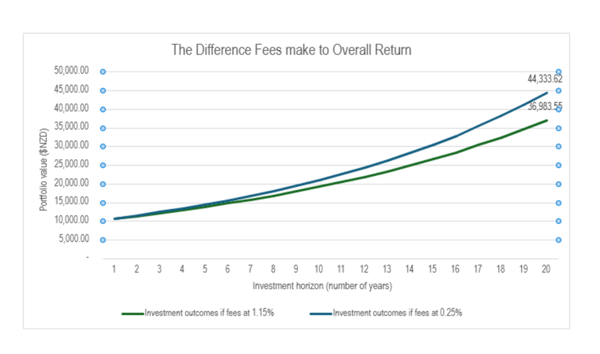 This is an overly simplistic example and doesn’t factor in any market conditions, other fees, or variations in fund performance
But a lower-fee fund is not automatically the better choice if you are comparing the wrong type of fund, or if the cheaper fund is not a good fit for your timeframe and comfort with risk. Kernel’s beginner’s guide to investment fees makes a similar point in plain English: fees should be considered as part of the total value you are getting, not as a number in isolation.
A practical way to use fee information is:
-
first, make sure you are comparing funds in the same category
-
then look at how fees compare across those similar funds
-
then weigh those fees alongside service, investment approach and longer-term performance
That gives you a more useful question than “Which fund is cheapest?”
A sound KiwiSaver decision usually balances fund type, timeframe, fees, service and longer-term consistency together. Sorted’s Fund Finder is built around exactly those factors, while provider tools such as ANZ’s Fund Chooser are also framed around finding the fund that may suit you best for your first home or retirement goals.
Switching is a decision, not a reflex
There are valid reasons to switch. You may be getting closer to buying a first home. Retirement may be much closer than it used to be. Your comfort with risk may have changed. Or you may have compared similar funds and decided yours has been consistently underwhelming.
But the case for switching is strongest when it comes from a clearer understanding of your needs, not just disappointment with the latest headline or market movement.
Consumer NZ recommends reviewing your provider and fund regularly, and especially when you are approaching a major goal such as buying a first home or nearing retirement.
Five questions to ask before you switch:
- Am I in the right type of fund for my timeframe and risk comfort?
- Am I comparing my fund with similar funds, rather than with a completely different category?
- Have I looked at fees, service and longer-term returns together?
- Am I reacting to a short-term disappointment, or to a genuine mismatch or pattern?
- Do I understand why I want to switch, and what I would be moving to?
These questions will not give everyone the same answer. But they do make it more likely that a switch, if you make one, is for the right reason.
The real goal is fit, not reaction
The goal is not to make a change simply because another fund looks stronger right now.
It is to make sure your KiwiSaver still suits your life, your goals and your appetite for risk.
For some people, that review will confirm that their current fund is still the right fit. For others, it may highlight a good reason to switch.
Either way, the better starting point is understanding what you are comparing, and why.
Sources used in preparing this article
- Sorted: KiwiSaver Guides, Tools & Useful Information
- Consumer NZ : KiwiSaver guide
- Kernel Wealth: How to choose a KiwiSaver fund
- FMA: About KiwiSaver

Leave a comment